A Desk-Sized Exercise in Pairing Two Unrelated References
Pair two unrelated references in a small creative draft by borrowing one quality from each, so both have a visible role without competing.
The most common mistake in pairing unrelated references is borrowing their subject matter instead of their qualities. A sketch that simply combines a lighthouse with a recipe card may contain both references, yet still feel like two ideas placed side by side. This desk-sized exercise helps you turn one quality from each source into a small draft with a reason to hold together.
Choose references you can inspect at your desk: a bus map and a ceramic bowl, a houseplant and a drum pattern, or a short poem and a hardware-store label. You will identify one quality from each, decide how those qualities might interact, then make a deliberately small piece. The aim is not to imitate either source, but to give each a visible role.
Pick distant references
Start with two things that belong to different contexts or serve different purposes. A transit map and a bowl differ in subject, use, and visual language; that distance gives you more room to notice unexpected qualities. Avoid selecting two references that already share an obvious style or theme, since the exercise is about building a connection rather than extending one that is already clear.
Use objects, images, sounds, or short passages that are available to examine. A library book, a photograph on your phone, a seed packet, a music track, or a note from your own writing can all work. Keep the sources in view or within easy reach, and write down what each actually does or looks like before deciding what to borrow.
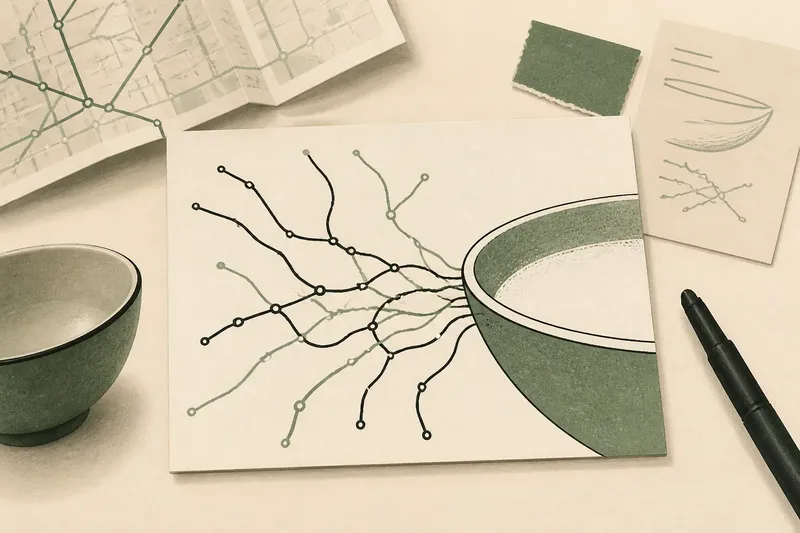
For a first pass, choose references that are rich in observable details but not so complex that they demand a long explanation. A folded street map offers routes, boundaries, labels, and junctions. A ceramic bowl offers a rim, a hollow, a curve, and a contained space. Those details make useful starting points without requiring either source to dominate.
Name one quality
A quality is a transferable feature, not the source’s identity. “Map” is a subject; “branching routes” is a quality. “Bowl” is a subject; “a curved edge that gathers attention” is a quality. The distinction matters because a draft can borrow a structure, rhythm, texture, or behavior without copying the source as an object.
Choose one quality from each reference. Keep the words concrete: “branching,” “crowded,” “quiet,” “rough,” “repeating,” “contained,” or “off-center” can help you picture a formal choice. If a word could describe almost anything, add a specific observation. “Uneven” is broad; “uneven spacing that tightens near the center” points toward something you can make.
Limit yourself to one quality per source for the first draft. Collecting several at once often turns the exercise into a collage of features, where the reader or viewer cannot tell what is doing the work. You can always add another quality after the initial relationship becomes visible.
Give them a relationship
Two qualities need an interaction, not just a place on the same page. Ask what one might do to the other: interrupt it, contain it, repeat it, soften it, conceal it, or change its direction. Pick a relationship that can be shown through a simple formal choice, such as placement, line, sequence, scale, or a change in texture.
Imagine you choose branching routes from a bus map and a curved, containing rim from a bowl. For a small ink drawing, you might let several thin routes spread across the page and bend toward a single curved boundary. The routes keep their branching character, while the curve gathers them into one visual destination; neither reference needs to appear as a literal map or bowl.
Before drafting, say the relationship in one plain sentence: “The routes gather at a curve.” If your sentence only lists the sources, the connection is not yet specific enough. Try a different verb until you can imagine a visible action rather than a theme you would need to explain afterward.
Start small
Choose a format small enough to complete in one sitting and easy enough to revise. A postcard-sized drawing, one paragraph, a paper collage on an index card, or a short loop of movement can keep attention on the relationship between the two qualities. This is a study, not a finished work, so leave out details that do not help that relationship read.
Set up only the materials your format requires. For drawing, a pencil and one dark pen may be enough; for collage, use scrap paper, scissors, and a glue stick; for writing, use a blank page or a plain-text document. A timer can help you stop polishing and inspect the draft, but it is optional. Work from the qualities you wrote down, not from a wish to reproduce the references faithfully.
Make an initial draft, then mark where each quality appears. You might circle the branching lines and underline the gathering curve, or annotate a paragraph’s repeated phrase and its enclosing sentence. If you cannot point to each quality, revise the draft itself rather than adding a long explanation beside it.
Where does pairing go wrong?
Why does the draft look like two pasted-together references?
Usually, each source has been represented literally, but neither changes the other. Remove the most recognizable borrowed image and ask what formal quality can remain; then give that quality an action within the draft, such as redirecting a line or shaping a sentence.
What if one reference takes over?
One source may have more details, stronger visual weight, or a clearer subject, so the other becomes a faint accent. Give the quieter quality a structural job, such as setting the composition’s boundary, controlling the rhythm, or determining where the eye pauses.
What if the connection feels forced?
The chosen qualities may not support the relationship you assigned them. Keep the references but change the verb, or keep one quality and choose a more observable quality from the other source; a genuine connection should be visible in the draft without a paragraph of explanation.
How can I tell when the draft is coherent?
Look for a clear relationship that survives when you stop naming the references. If a viewer can notice a repeated direction, a boundary that gathers forms, or a rhythm that changes in response to another element, the pairing is doing visible work. It need not make the sources look alike.
Revise the connection
Inspect the draft for the point where the relationship becomes hard to see. If the two qualities appear in separate corners, bring them closer or let one cross into the other’s space. If they overlap so completely that one disappears, restore a contrast in weight, texture, spacing, or placement.
Make one revision at a time. You could remove a literal symbol, shift a boundary, vary a repeated mark, or rewrite one sentence so the second quality affects the first. Changing several things together makes it harder to tell which choice helped, while a focused revision keeps the exercise manageable.
Then write a short note naming the source qualities and the relationship between them. For example: “Branching routes gather at a curved boundary.” This note is not a caption that rescues an unclear piece; it is a record of the decision you made, useful if you return to the draft later or want to develop it in another medium.
Carry the pairing forward
Decide whether the draft is complete as a study, needs one more revision, or suggests a larger project. If the relationship reads but the piece feels spare, preserve that clarity before adding detail. New material should deepen the interaction, not merely make both sources more recognizable.
For a next version, keep the same two references and change the medium, or keep the medium and change how the qualities interact. A branching rhythm that gathered at a curve in a drawing might become sentence fragments that settle into a long, enclosing line. That shift lets you explore the same pairing without repeating the original draft.
This desk-sized exercise works best when you treat the references as sources of decisions rather than ingredients that must remain visible. Keep the first draft nearby, note which quality carries the connection, and let that observation guide your next choice. A small piece can hold two distant ideas coherently when each one changes what the other is allowed to do.